– April 2026 –
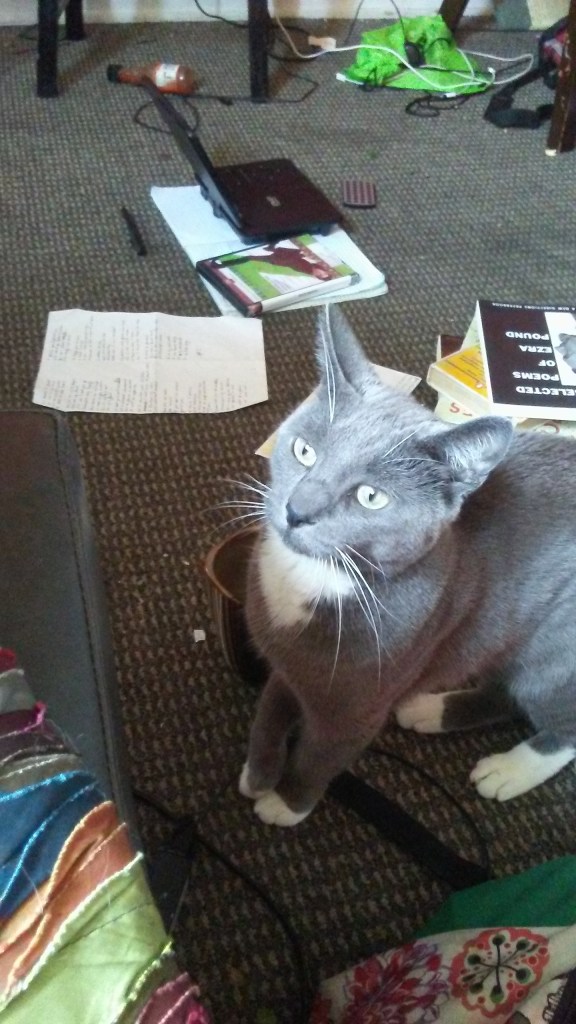
We had books, but I never saw my mother read. They lay on the floor along the wall, stacked three or four high and towering like a jagged monument to a life she might have led, or one she led before. She worked, and stayed out, and the books were my unplanned inheritance, a bequest she left on accident, which enriched my life without her knowledge. They were fodder for my dreams of who she might have been.
What did she think of The Screwtape Letters, a work I didn’t understand but whose cover I always admired, embellished as it was with a wax seal and regal cursive script? Was Easy Rawlins her fictional crush, the perfect man if only he could leap from the page? When did she get her time-tattered cover of Dean Koontz’s Mr. Murder, and would she have guessed that years after she read it, if she ever did, her preteen daughter would crease its thick spine on an afternoon she suffocated in the stuffy house alone?
It was the first thriller I’d ever read and, ten years later, remains the most important one. I felt the free luxury of Koontz’s divinely textured world, whose heart-thumping tension I suffered each time I returned to my place. No matter the cockroach colony living behind the refrigerator, nor the sponge-bath weeks without hot water. Forget the loneliness of the cafeteria and the quiet of the home, which somehow hurt worse. This was the first book I ever loved and the first work in which I lost myself, where I saw how a phrase could encircle me like an embrace. It provided escape when I needed it. It projected before my eyes a drama of genetic cloning and epic fights, the mystic and the impossible — among them, the devotion and affection of family life.
Koontz stirred in me a love of reading when I was in seventh grade. But by the time I became a teenager, my tastes had changed, driven more by the need to see myself, to find company in characters, than by the desire to escape from my reality.
I was a 14-year-old Black girl, but I liked the gruff, dispossessed white men, the down and out authors writing obliquely about themselves decades before we called it auto-fiction and before it became the memoir of the new intelligentsia. I lay alongside Henry Miller and his prostitute in a Paris apartment, on the wrinkled sheets of a bed damp from sex, even as I sat alone in my family’s cheap apartment on Chicago’s West Side. I took the bus to school an hour north while Charles Bukowski and I delivered mail in the rain, earning just enough to rent another night. I climbed out of a boarding house window with John Fante to lounge on a green hill in the sun, peeling clementines so the white of the rind stuck to my hands, all as I only gazed from a dirty window down to the empty boulevard. And I’d look up from my book, from the stories of the writers I called my idols — mid-sentence or with the flip of a final page — and return to myself.
In pictures I took on the cracked Android I had then, my cats wind through piles of DVDs, CDs, and books I’d checked out from the public library. There’s a sheet of copy paper with lines scrawled in ballpoint pen in the written cadence of verse — doubtless one of the songs I’d sung with the guitar I could never quite tune. Inexplicably, there’s a bottle of Frank’s Red Hot lying on its side and a stack of books sleeping next to it. I could hear the plastic click of my brother’s Xbox controller and his furious and bemused insults shoot from his room down the hall. My mother’s door was closed, her room silent.
That was the summer before my first year of high school. Initially, I had an unpaid job as a junior counselor at my elementary school’s summer camp. I quit one random day in July, feeling suffocated and wanting instead to ride the train back and forth, and spend chunks of hot afternoons browsing the fiction section on the seventh floor of the Harold Washington Library Center. That was where I first saw Bukowski’s Sifting Through the Madness for the Word, the Line, the Way. Its paint-flecked cover and mint green spine; its title in bold, black letters; the way it seemed to announce itself even among the clamor of the library shelf. The first poem was, “so you want to be a writer?” So I did.
I’d carry the thick work under my arm, 400-some pages, as I walked home from the bus stop after a day of delinquent wandering. Or I’d take its hard cover in my hands and crack it at a stoplight, stealing glances at stanzas that would knock around my head for the next two blocks — something about the freedom of poverty, the dirty glory of the racetrack, the understated excellence of a well-composed phrase. Those were alien ideas to me then. But my feet traced over the cracks in the sidewalk and stepped around so many shards of broken glass, even as my eyes ran along Bukowski’s wild lines. Once home, I opened the door to no one. My mom must have been at work, my brother so distant as to be absent. And the hot tar street was my lot in the summer, the humid silent night.
Bukowski, Fante, and Miller knew this somehow. They wrote for me, a teenager in North Lawndale. Their novels, set in boisterous downtowns or within the walls of some filthy rented room, were a sort of fun-house mirror: I saw myself and my own life reflected but distorted; there were circumstances I recognized, a shared disenchantment with a world we felt had betrayed us — and a chasm of time, place, and perspective that didn’t register to me then. My reading was a sort of alchemy, those writers’ lives the stuff that comprised my own.
During the rainy days of Chicago’s West Side summer or the sharp pangs of adolescent sadness, books were boredom-busters; outstretched arms; vessels in which I stored stifled cries, and valves that released them to the air; messages in bottles set adrift in the vague direction of my future self. Nothing less than essential. But even as a child, I had the sense that reading was superfluous for my mother. She considered it a pastime only relevant when one has time to waste, an exercise only welcome without the stress of work and paychecks stretched too thin.
She had moved up near the Wisconsin border by the time I was halfway through high school, while I stayed with my aunt, her sister, in the city. I knew her work life was less hectic since she’d taken a remote customer service position, and her days were mostly quiet save the bark of her dog and the chatter of her television. Still, I imagined her in that new apartment as I remembered myself in our old one, grasping for a mirror or else for an escape hatch. And I wanted to share reading with her as it became a larger part of my life, to evangelize the freedom I discovered that boring summer afternoon when I realized that even as they shriveled and grayed along the wall, our books were evergreen.
I gave her the memoir of a popular Black actress on Christmas or her birthday. She still had no bookcase, but it didn’t matter; she had but one book. Sun Tzu’s The Art of War. I never knew why she had it or where she got it, and it never seemed right to ask. It sat on the bottom shelf of a black glass TV stand in the shadow of a flatscreen, beside a case of dominoes and a rolling tray littered with pot and ash. It seemed paralyzed, inert; it lay mute while everything else moved around it.
The memoir, she put in my bedroom — better called the room I slept the few times I visited. It lay atop a heap of my old schoolwork as if it was mine, as if it had been a gift to myself. Perhaps it was.
Hundreds of miles away and years later — far from Bukowski and my mother’s books, silent for lack of her voice — a group of strangers took turns reading to each other, two pages at a time, to finish the 304-page novel before the weekend was over. It was the spring of 2026, and Elisabeth Egan had traveled to an idyllic estate in Monroe, NY, to participate in a Page Break reading retreat. Egan, a writer for The New York Times Review of Books, calls herself more “Jersey Shore/airport bookstore” than “Brooklyn literati,” but she “signed up for this artisanal retreat because [she loves] reading aloud and being read to, and [she] welcomed the idea of reading a whole novel in turns over one weekend.” There was yoga and a bonfire hang, meals inspired by the novel prepared by a private chef, a virtual visit from the author, and a community of “strangers [who became] people with whom [she’d] shared an experience that felt important.” Egan began to know the other participants by their voices, to develop her preferences for the most mellifluous readers. With one discounted spot on each retreat reserved for a transgender, queer, or POC reader, the typical price tag was between $950 and $1,300.
In the face of such retreats, where, Egan notes, the usual clientele appear “young and cool … on Page Break’s Instagram,” it is not such a wonder that the Internet has taken to criticizing so-called “performative reading.” It occurs when a tote-wielding man brings Pride and Prejudice to a crowded bar, or when a 20-something produces Kurt Vonnegut on the train. It is the conception of reading as something one does “to market himself, to portray to the world that he is indeed deeper and more expansive” than everyone else, as Brady Brickner-Wood writes in The New Yorker.
That reading is solely the pleasure of the wealthy is not a new idea. Per Flora Champy, a professor of French at Princeton University, even Rousseau saw in the 18th century that for the elite, “reading is simply a way to assert their superiority by enjoying more sophisticated distractions than the poor.” Indeed, recent research demonstrates that although all Americans are reading less, the highly educated and high-income are still more likely to engage with books than the least-educated and low-income.
The result is a dual ideological assault on reading. The charges levied are that reading is out of reach — who has the money to spend on a luxury read-aloud retreat? — and that those who do read are feigning access to that exclusive club in an attempt to demonstrate their difference from the common, TikTok-scrolling rabble. But performative reading is difficult to do; unless one’s eyes are closed and the book is upside down, one would seem to have successfully engaged with a written work. The trouble is that a stigma against reading as hoity-toity, and a conception of reading as inaccessible, can contribute to its disappearance from the lives of those who need it most — women like my mother, children like I once was.
My friends and I didn’t have $1,000 to spare in high school. Besides, Page Break hadn’t been founded yet, and performative reading had yet to enter the common parlance. But we had library cards and a study, a kitchen table and a warm lamp. An older friend of my classmate Toby’s family decided to spend the Covid years with her children in Florida, leaving him to watch her house in a college town just north of Chicago. I moved in for a time after trouble at my family’s home, joining him, Zachary, and Ryan. With the three boys graduated, I in virtual classes, and the world fluttering in and out of lockdown, we read together for long hours in happy silence, disturbed only by one of us cooing a passage to the others.
Toby was reading Ishmael by Daniel Quinn at my recommendation, then Camus’s The Plague. Ryan Sirens of Titan. Zachary probably some work of philosophy. I don’t remember what I carried around with me then — but I know that if I picked it up again, or spied its spine on the shelf of some musty bookshop, I would surely recognize it. The memories of that time would travel back to me as if they were written within its pages, scrawled like marginalia on a night I stayed awake too long. Now, I remember Roger Rosenblatt’s emotional plea in The New York Times, urging readers to recognize what’s vested in their old books. “Every book you have is a story of who you are and who you were when you acquired it,” he writes. “And who you became when you read it. It’s a part of you, your present and your history.”
Champy finds the same power in Proust’s experience of reading: books “shaped his apprehension of life by preserving indelible impressions of his surroundings. Relatives now long gone, places he hadn’t seen in years — these were nevertheless still present in his mind through memories of his readings. Books helped keep past sensations alive.”
In this way, books are our common inheritance, though they hold for each of us a singular importance. This is the magic by which stories of white men in Los Angeles became a means for me to explain and understand my life in the hoods of Chicago; how reading, far from being something I associated with my wealthy classmates, was the cheap entertainment only a latchkey kid could enjoy. I read Dean Koontz and Charles Bukowski, arguably a budget Stephen King and definitely an anti-plot misogynist, respectively. But as Champy understands it, “the ‘miracle’ of reading, in [Proust’s] view, does not even depend on exposure to good writing. Mediocre books and poor writers serve just as well.” The important thing is that in encountering a toiling writer, “you open up your deepest self too, discovering new spheres of experience you would never have imagined or fathomed before.”
Books are versatile and fluid, rushing to fill the shape of whatever vessel they’re placed in: the aching heart of a middle schooler or the brilliance of a university scholar. It matters not so much to read great books as it matters to read any book at all. What matters is to connect with the writer, to discover oneself, to come closer to those with whom one reads in community.
“Read to me?” Zac asked. He looked at me from the driver’s seat and smiled. “You don’t have to. But I’d like it.” I clicked on the car light and rummaged in my bag for Oxford Editions’s A Very Short Introduction to Artificial Intelligence. I read him AI, our sort of pet name for the work, on long drives to Vermont or New York City, or as I sat at the kitchen table in a candle’s flickering glow while he moved busily at the stove. More a reference than a narrative, there were names I couldn’t remember and innovations I didn’t pretend to understand. He explained them happily, apologizing sometimes when in thirty minutes we’d only made it through one page because of his excited interruptions.
When I asked him what back-up book I should bring on an upcoming trip, he offered, “AI?”
“It’s not really a book I can read on my own.”
“I know,” he said.
I wasn’t sure exactly what we meant, but I knew it was true. Whether it was the habit we’d formed of only reading it together — Zac seldom read alone — or the awareness that the work itself was not as enjoyable as the conversations it spurred when we read in each other’s company, or the mere fact that I did not have the knowledge base to make sense of it on my own — we knew that this slim book was a shared thing, an object whose importance issued only from the meaning we shaped from it together.
A few days later, I sat on my friend Joelle’s carpeted floor in a house in Chicago’s northern suburbs, eyes skittering across her bookshelf. It’d been a couple of years since we’d last seen one another, and perhaps her library changed as her personality did. I recognized some titles and felt like I was seeing others anew. Her Jojo Moyes reminded me of one of my fifth grade classmates, a precocious girl who always had Me Before You squarely at the corner of her desk. I said that I had meant to read Anne Frank’s diary; Joelle said she stopped reading when Frank wrote about her crush, too young at that age to understand attraction to boys. Then she mentioned a collection of magical realist short stories she’d loved when she was younger.
“I’m not sure if it’s actually as good as I thought it was back then.”
“What was it called?”
“I don’t remember. Let me look.” She rose from her bed and came to the shelf. Seconds later, she put her pointer finger on the top of its spine and tipped it toward her at an angle — that precious maneuver — and handed me the book. “Do you want to read it to me? You really don’t have to.”
“No, no,” I said. “It’s all right.”
I started at the beginning, a story about a girl who refused to open a birthday present from her parents. It’s perfect as it is, she said.
As I read, I imagined the worlds swirling in my dear friend’s mind. Did she feel the papery scratch of the book open on her lap under her school desk as she cast furtive glances downward, tuning out the teacher’s droning lecture? Did she feel the rumble in her seat as the school bus crashed over potholes at the end of the day, scattering her vision and making her lose her place? Did she picture this moment, I leaning on my elbow with my legs crossed and stretched long, my voice sometimes stumbling, compelling me to repeat a couple of words — she sitting cross-legged on her bed with her chin resting in her hand? Did she see this moment laid upon the palimpsest of this book, its marks invisible but its psychic weight felt every time she lifted it from its place on the shelf?
Echoes of past voices ran like a current under the words I now read to Joelle. Zac’s uncertain tenor feeling its way around “The Ancient Mariner” some nights as we fell asleep. A second grade teacher dramatizing a picture book. My own voice barely reaching the walls of an empty apartment, darkened by my mother’s shadow and somehow smothered by the silence. Reading was the solace of nights and days, my eyes bloodshot and burning, closing with the weight of sleep and opening against it again and again. All these incantations I recited to myself in the clamor of the lunchroom and the hush of my bedroom after bedtime, when my aunt’s footsteps — shuffling along the carpet and creaking on the floor — could extinguish my lamplight as if it were fragile as a flame.
 Finley Williams