– April 2026 –
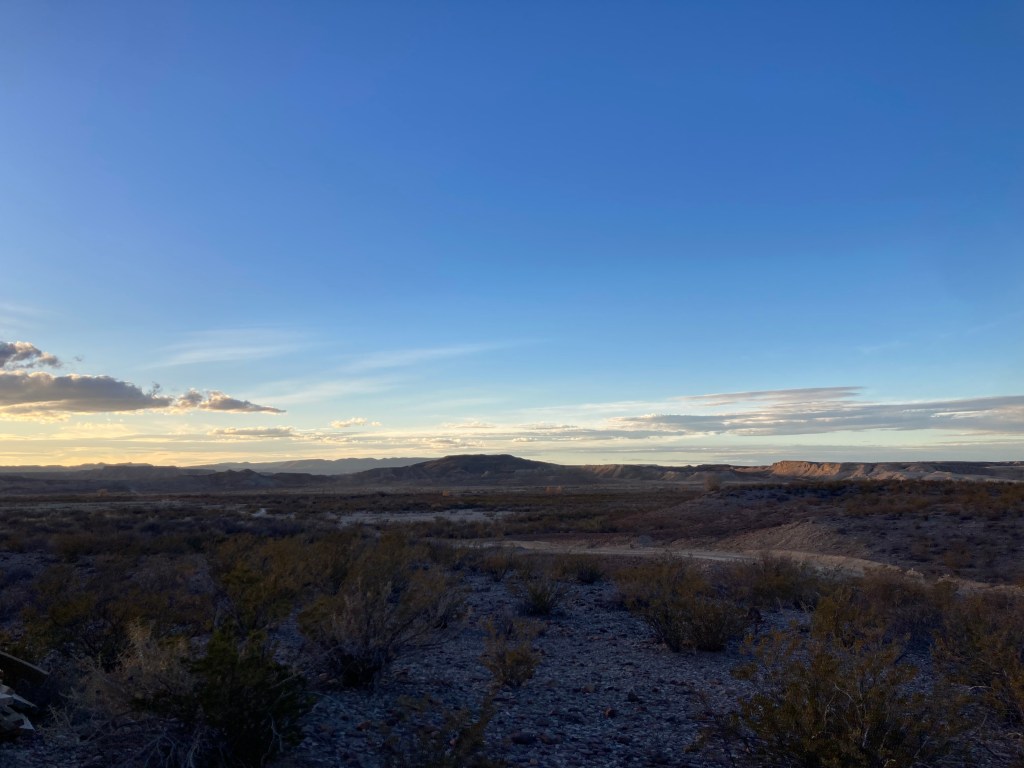
It took ten hours to get four hours of sleep in the desert. At least it did for me, unfamiliar as I was with the chorus of howls and air. Anxious for rest, I tried to count the things that were the same: The rattling tent flap zippers were coins jingling silver music as they shook in a cup on the streets of my native Chicago. When the wind found a high resonance, or squeaked through an earthen nook, it was the ghostly wail of a siren blaring down a nighttime avenue.
I knew, though, that Chicago was a creature altogether different from this desert. The latter was an assembly of homes scattered haphazardly and miles apart; it didn’t bother posing as a municipality. There were no wells and no utilities, though it looked like tunnels had been dug to lay them. There was no city center with towers that rose from the hard earth — only the palmettos tilting in the breeze.
With those few empty desert hovels behind us and the broken-down roadway falling below the sand, we turned to watch an unpeopled horizon. Z held his graphite against the lines that composed the land. He drew a green and brown gully where wind whistled through tangles of desertscrub. Beyond that, he sketched a low mesa peckered with caves. Farther beyond that, mountains’ pockmarked faces, which blinked in the path of the sun — sentinels of a new and old land.
We were staying in a large yurt on a five-acre campsite miles off Terlingua Ranch Road, its only amenities a firepit and an outhouse with a composting toilet. An empty camper lay across an improvised path, and a small eco-ranch stood down the way. With solar panels and bio-mimicry architecture, it sported a sign that said “visitors welcome.” We knew there were few in this desert; we saw no cars, and concluded we were alone.
And alone, we passed nights and days. We wondered at the land’s emptiness, how it held tension with the gaggle of real estate signs marking the entrance to the makeshift road. It unrolled itself into the desert, even though the desert did not ask. As our SUV bumped over divots in the earth, Z said, “Whichever developer or real estate agent owns these plots should have dug out the sand around the path, not the path itself. Rain, when it comes, will run into it instead of away from it.”
We guessed it was dozens of miles long, unfolding so deep into the pale sand that only the donkeys and snakes would venture there. But we had ventured here. Not into the lost core of the desert, but to its fringes, where land was bought and sold and rented, where structures sprung up like dust devils, unpredictable and unplanned. There were few who dwelled here in this yet-unpopulated place. The odd buildings and campers, the signs hawking cheap and vast tracts of land, the presence of our tent in a landscape previously unsettled — they told of a community not ready to be born.
The place was called Marfa Burritos, named for what it serves and where. It was an hour before the counter-service restaurant was set to close, but there was still a steady flow of customers ambling through the wrought iron door that slammed shut if you didn’t care to catch it. The store was quiet, the air warm and heavy. No one spoke but to order, though eyes wandered over the off-white walls, blanketed with Sharpie messages in multicolor ink. Texas Forever. Luis Works Here. A heart with six initials and the year 2024.
Z and I were newcomers, visiting Marfa as a waystation on the journey from our campsite to Big Bend National Park, where we planned to hike the 14-mile Marufo Vega Trail. Still, I felt I recognized the place. It seemed to not have changed at all since American journalist Richard West had written about it in 1977. “Marfa stores reflect the no-nonsense character of the land,” wrote West in Texas Monthly. “Their signs advertise necessities: ‘Feed,’ ‘U-Gas-Um,’ ‘Patent Medicines,’ ‘Groceries,’ ‘Furniture,’ ‘Credit.’”
West describes a mid-20th century Presidio County — where Marfa is located — desiccated by desert winds and thus destined to forever hang in time. In examining the earth-based industries that had historically created wealth in the region, he admits that “[t]he land has proved no easier for people seeking profits below the land than for farmers and ranchers coaxing along crops and livestock.”
But a new way of profiting from the desert landscape — one West could not have imagined, not oil or uranium or farming or cattle-raising — is making its way through Texas. At Marfa Burritos, a copy of the Big Bend Sentinel from December 2025 lay splayed on the table. A headline on an interior page asked, “The AI data center: How serious is it?”
“Marfa grasslands, long inhabited by grazing cattle, could soon be the site of a multi-million dollar data center established to meet the growing demand for artificial intelligence,” a different Sentinel article warned. The project, funded by a joint venture whose partners include OpenAI — the maker of ChatGPT — and Oracle, is a part of a larger boom of data center construction in Texas.
The data center will use state of the art technology, solar power, and energy production, according to a Presidio County judge. The county commissioner indicated that “the AI data center has the potential to bring about lasting change to the region in the wake of the economic collapse of the cattle ranching industry.”
Even forty-eight years ago, West understood Marfa as a land that held fast to the past, to the roots that fastened the cattle grass to the ground. “On the Highland Plain to the north, Marfa [was] in some ways almost an ideal American village of Thoreau, of Whitman, of early Mark Twain,” West wrote. It was “the village store cracker barrel, but set instead on the open road and far horizon, a small town on the clear uncluttered sweep of a high grassy plateau.”
Larry Burnett found an identical Marfa in 2012, writing in Fathom that with its “vast emptiness,” “the mysterious little desert town of Marfa [is] the same as it ever was — retro and futuristic.” Burnett notes that the town’s character has remained stable: “The only national chains within city limits are an Exxon and an old Dairy Queen, but even these are far enough away to not spoil the town’s ghostly appeal.” West observed the same in 1977: “There are no fast-food franchises in the county, no golden arches, Kentucky colonels, or huts selling pizza.”
Nothing short of miraculous that Richard West, Larry Burnett, and I could step into the same place, not only physically, but in time. So Marfa clung to the past not with white knuckles, but with gentle dignity. The town and its people kept their traditions with the persistence of the Marfa Lights — two glowing specks far in the distance, first seen by a cowhand in 1883, and still marveled at today by Texans astounded by their bright mystery.
But my first time in Marfa, my first visit to Texas, I saw the town teeter on the edge of a transition. It was a change observers said Marfa had so far fended off — not with protest or petitions, but with the steadfast belief in their own ways of life, and the easy resistance of the land itself. Now, where the great cattle days of the 19th century still ran like a rumor from the lips of old ranchers since dispossessed, “the last frontier” — as West titled his article — was the very vanguard, the first wave of a grand push west for the new technological frontier. Two of the world’s biggest technology companies staked their claim to the future in a land that many saw as timeless. In another fifty years, will West’s portrait still be true?
Texas has become the most in-demand data center market in the country, displacing Virginia. This is in part because data centers are typically built in energy-rich areas, “making West Texas an appealing region due to its natural resources, access to natural gas pipelines, [and] cheap land” — but “one natural resource in short supply … is water,” according to the Sentinel. As West reminds us, in the 1800s, as in the 1970s, as now, “the land remains, as always, cattle and desert country where making a profit depends on rainfall.” He cautions us that the way of the land is an arduous one, leaving hands calloused and backs bent at odd angles — leaving families impoverished and small plots consolidated.
But West’s most instructive revelation might be his understanding of how profit-seeking fundamentally morphed people’s relationship with the land. Oil, while ensuring riches, “degraded the land and people’s feelings toward it. The land, which had been heroic and mystical, a link to one’s past as well as to one’s sustenance, became merely speculative capital.” I read these lines and heard the deafening whirr of turbines, the ceaseless pump of water in a dry place, the cacophony of a new industry rapacious as the ones that came before.
In the ’70s, West observed that “Presidio County has escaped the amenities and deformities, the population spurts and cash flows, the drastic psychic changes that accompany the discovery of oil.” In 2026, though plans for the Marfa data center have not progressed, West’s profound realization carries a heavy and inescapable reminder in the vast, empty expanses of West Texas, where the arid earth is its only asset: “For Marfa and Presidio County and the people living there, the land is their blessing and their curse.”
And the highways rose and fell. They climbed above us on elevated lanes and crashed back down to sea level. As we drove from the Austin airport to San Antonio on I-35, I almost mistook the on-ramps, off-ramps, interchanges, skyways for braided streams, not unlike the ones winding through Big Bend National Park. Though the streams were dry then in December, with the water locked high in the ice-heart of the Chisos Mountains, the highways were slick with cars.
Z still saw the beauty in it. He was a landscape architect, a builder of urban parks and rural train stations. He smiled and pointed to Texas bridge rail, reinforced concrete safety rails pioneered in the state. He noted the Jersey barriers, highway dividers with a slope at the bottom, that lined the road at its shoulders. He saw a city taking shape and wondered at its opportunity.
Later, an Uber driver in Austin told us he remembered when this long mega-road between the two cities was just country. He’d come out from Lubbock with his brother and ride out there where the earth felt as open as the sky. I felt myself with them, breath caught at the imaginary sight of a horizon unmarred by interstates, where the only lines were those left by clouds angling above the horizon.
But H-E-Bs and Rooms to Gos, Walmarts and McDonald’s, stood garish upon the landscape. And as we drove, lanes merged and closed and bridge bents rose while bridge girders stood empty as expansions waited to be built. Z called them the highways of the future; yet to be constructed, they were a promise or a threat.
West wrote that if there’s one shared feeling among the people of Presidio County, “it is a distaste for cities … Dallas, Houston, and so on. City folk, they say, don’t understand the peace that comes from living with eighty-mile vistas.” So the potential of the ever-expanding highway clashes with its dark peril: Would it ever reach Marfa, cause a boom like the days of WWII, when Army bases brought handsome GIs who danced at the bars on days off? Would the data center and its thousands of promised employees bring wealth and greater growth — would it displace the small town’s character in the process?
Perhaps, West writes, the old West is destined to disappear. “But that future, like so much else, will be shaped far from Presidio County—in Congress, in big corporations, in the government bureaucracies.”
We rode the undulating highways until we reached the Lady Bird Johnson Wildflower Center a ways south of Austin, where the descendants of Mighty Oak trees stood in a circle — the Hall of Texas Heroes — each one with a plaque describing how it watched or facilitated as history proceeded. The plaque for the growing sapling of the Old Evergreen Tree in Lincoln, TX, said that a French-Canadian trader explored the lands along the Rio Grande, and “when he reached the plains east of the Hill Country, he rested beneath a huge oak tree.”
In the 1850s, a town called Evergreen sprung up around the tree, but “bypassed by the railroad in the 1870s, nothing remains of the town except the tree and the picturesque cemetery across the road,” the plaque reads. While the absence of the railroad left “[t]he seemingly indestructible tree” intact, a new industrial blight threatens to deform the desert.
There was a picture of the oak in front of what seemed to be a white barn, a tractor tire leaning against it. Its trunk was split into three or four channels, reaching upward. The picture’s primary colors were sun-bleached and pale. It seemed a place out of time.
In front of us, at the gardens, a juvenile oak wore a rounded crown and stood upon a maturing trunk that bisected like a stream. Its leaves blinked through wind and sunlight.
With the urgent thought of data centers and the memory of our far desert campground, still grasping for its sense of self, I wondered what landmark would give rise to that community in the desert. And what will stand when it falls? Will that long path become a waterway in the rainy season? Will it blow over with sand until it is flush with the rest of the dunes? There were no trees there, nowhere to find shade on hot desert noons, nowhere to preach or trade beneath the heat. West is sure that “[h]owever furious the changing of ranch titles, the country will remain the same. It is too far, too isolated from mainstream Texas, too wild and rough to become urbanized.”
I hope he is right — that Marfa and the desert campsite will remain lonely and remote, a home for those whose ghosts haunt the land and a waystation for those passing through — even as the cities metastasize and pavement swallows the sand. But I fear that people and power far from Texas will continue to cohere this scattered and unpopulated region, without care for the land itself — where the earth nourished cattle and offered alfalfa and bright green chile peppers, where the silence of the dunes was the solace of cowboys and townspeople, disappearing now beneath a future that threatens to arrive at last.
 Finley Williams